التسميات

الاثنين، 17 مارس 2014

Exposed thermocouple junction | tip insulation

As we know, there are three types of thermo-couples according to junction type:

- Grounded junction
- Under-grounded junction
- Exposed junction


The following are some methods to electrical insulate exposed junction:

Using hot shrink tube:
A shrink tube of the correct size may be used to electrically insulate the exposed junction of thermocouple.

Using PVC insulation tape:
This is a very simple method but the PVC tape has low thermal conductivity.
Using beryllium oxide:
Source: http://www.instructables.com/answers/I-am-looking-for-a-material-that-is-thermally-cond/


The most thermally conductive electrical insulator is beryllium oxide.  It has the thermal conductivity of metallic aluminum and the electrical conductivity of aluminum oxide.  Insulating washers of this material are available to fit most bolt-down  transistor and diode cases, and this is the only practical way to use it, since BeO is a hard and very refractory ceramic.  Note that BeO dust is carcinogenic.  It's not hazardous in pieces too large to accidentally ingest, but don't even think of grinding a notch in a BeO insulator to fit an odd corner.


Thermal conductivity [W/m.K]

Dielectric strength [kV/mm]
330
Water resistance
Yes
Wear resistance
Yes
Maximum temperature (melting point)   [°C]
2507

Using motor | transformer winding enamel | insulation

Key words: wire enamel, insulation varnish


Thermal conductivity [W/m.K]

Dielectric strength [kV/mm]
3.3
Water resistance
No 
Wear resistance
No 
Maximum temperature [°C]


Using thermal conductive silicon pads

Using mica


Using diamond:

Diamond has the highest thermal conductivity on earth. Also, it has a very high hardness, so it is wear resisting. It can withstand high temperatures. For sure, diamond does not seem to be an economic solution in most cases.


Thermal conductivity [W/m.K]
 2000
Dielectric strength [kV/mm]
 1000
Water resistance
 Yes
Wear resistance
Yes 
Maximum temperature [°C]
 Min. 3500

Using thermal conductive epoxy:


This method seems to be the most feasible and simple preparation method for relatively low temperature range. Thermal conductive epoxy is used in electronics field to seal components that are sensitive to water for water proofing like and in solid state electronic components like relays, diode bridges, and thermo-switches.

Epoxy pack is composed of two tubes (materials): one contains the resin and the other contains the catalyst.

The method is already used by Omega engineering for thermocouple types J, K, T, E (check the link below):
http://www.omega.com/pptst/TC-PVC_EPXOY_TC_PROBE.html

The highest thermal conductivity Omega provides provide is 0.712 W/m.K [model OT201]

3M adhesives (one of the leading companies in adhesives) also produces thermal-conductive epoxy with two options:
* 1-1.4 W/m.K [code TC2801]
* 0.72 W/m.K [code TC7207]


Thermal conductivity [W/m.K]
 1.4
Dielectric strength [kV/mm]

Water resistance
Yes
Wear resistance
Yes 
Maximum temperature [°C]


الأحد، 9 مارس 2014

Refrigerator star rating

Each domestic refrigerator-freezer has what we call "Star rating". Star rating defines what is the storage temperature of the freezer compartment is. The lower the storage temperature temperature in freezer, the longest frozen food life is as the activity of micro-organisms is reduced. 

One star refrigerator-freezer has a storage temperature lower than or equal -6 C.

Two stars refrigerator-freezer has a storage temperature lower than or equal -12 C.


Three stars refrigerator-freezer has a storage temperature lower than or equal -18 C.


Four stars refrigerator-freezer has a storage temperature lower than or equal -18 C, but has a freezing capacity higher than 4.5 kg/100 L of the freezer's volume.


A question is: why freezers are rated using stars?!!!!

The answer simply is: it is inspired by the snow | ice flake shape under microscope which in most cases have the shape of the star.


السبت، 1 مارس 2014

Some funny facts about refrigerators

Nowadays, each house has one or more of these appliances:

- Food preservation appliances: refrigerators, refrigerator-freezers, chest freezers, and upright freezers
- Food preparation appliances: gas cookers, electric cookers, induction cook-tops, microwaves, and friers 
- Fabric care appliances: automatic washing machines, half-automatic washing machines, manual washing machines, driers, and electric iron
- Water care appliances: electric water heaters, gas water heaters, solar water heaters, water dispensers, water boilers
- Air care: air-conditioners, fans, and heaters
- Other


The following funny facts apply on refrigerators:

- Refrigerators are the most basic and high-priority appliances in each home
- Refrigerator is the only appliance that is connected to power source during the whole year
- The only appliance that is running for the whole year
- Refrigerators have wide variety of structures and layouts
- The most difficult appliance to dispose
- Normally, the longest appliance in home
- Also, the heaviest appliance in home
- The most difficult appliance to transfer.
- The most difficult appliance to repair with the available hand tools at home
- The most user-interacting appliance at home, this is why memos are stick to refrigerator doors!!!
- The only appliance you must run even if it is empty
- Refrigerator doors are the most mechanically-reliable doors in all appliances
- The only appliance you care about when electricity is cut off
- Number one appliance that can be used for built-in layout with door-on-door layout.
- Number one appliance that needs no utilities except for electricity.
- The most appliance that has been integrated with touch screens, and remote-control
- The only appliance that you can place large amount of staff on top of it!!!
- The first appliance to have lights inside it
- One of the most needed appliances for singles!!!


الاثنين، 24 فبراير 2014

Blogger image white color test

In this post I show a bug in blogger image encoder. When uploading images with white color background, the white color is displayed as light grey for some image extensions. I tested these images on Google chrome and internet explorer and does not seem a problem of the browser.The following are some tests for different image extensions.


Selection of measuring devices

The following points are helpful when selecting most of measuring devices:


Storage conditions:
Storage temperature and humidity

Working conditions:
Ambient temperature range
Humidity range

Sensitivity:
The minimum unit | step of measurement

Maximum measurement value

Auto-range or manual range:
Auto-range is preferred for non-professionals and for time saving

Resolution:
The number of right digits that can be displayed

Display | Screen type:
- Mon-color
- 7 segment or 15 segment display
- Dot matrix display
- Color display

Display | screen size:
The dimensions of screen

Display graph

Measuring units:
Different measuring units save the time of unit conversion

Response time | Stabilization time:
Time needed to reach the true value.

Hardware overload protection

Accuracy:
Tolerance of measurement +/- as an absolute value of a percentage of full scale reading. How much far the measured value from the actual value.

Precision | Repeat-ability:
How often the reading is repeated or how near the measured values.


Linearity:
How the electric signal is varying with the measure physical property. The higher the linearity, the lower number of points needed for calibration.

Sampling time:
The frequency of updating measurements

Recording/logging

Internal memory size:
Internal memory size for storing measured values

Power source:
- Direct AC current (internal adapter).
- Voltage range and frequency
- AC current with adapter
- Internal battery:
- Battery life
- Maximum battery on time
- Internally-recharged
- Externally recharged

On-screen battery indicator

Ruggedness:
The maximum drop distance after which the device malfunctions or is destroyed

Auto-power off time

Portability

Calibration:
-Has traced calibration certificate from NIST
-Can be calibrated: offsets can be saved in the device

Computer interface connection:
- RS 232
- USB
- HDMI
- Wireless

Computer software
- Device configuration from PC

PC-Online reading | recording

Open channel/not connected probes | sensors detection

Wrong probes | sensors connection detection:
This function is useful in multiple-function measuring devices

Replaceable overload protection

Device sealing | Keypad sealing

Device mounting options:
- Adjustable legs
- Magnetic -mount
- Screw mount

External Vs. internal sensor

Taring | Zeroing

Hold manual Vs. Automatic

Minimum, maximum, average

Counting:
This feature is available in tachometers, and balances

Programmable limit alarm

Buzzer sound quality

Probe length

Probe dimensions


الأحد، 23 فبراير 2014

Cold appliances/Refrigerators/Freezer test analysis Excel add-in

For domestic (house-hold) refrigerators, refrigerators-freezers, and freezers being tested according to the standards IEC 62552, ISO 15502, or ANSI/AHAM HRF-1-2004; I have developed an Excel add-in that help in analyzing test data recorded by data acquisition system (temperatures, pressures, electric current, voltage, power, power factor, energy consumption).

What is really good in this add-in that it can be helpful for any laboratory/test engineer regardless the software used in acquisition. The add-in is programmed based on the field experience. It also can work with any number of temperature or pressure measurements. No matter how large the measurements record is large.

The add-in has two versions: one for Microsoft Excel 2007 and the other for Microsoft Excel 2010 as it is has the standard office ribbon control. It is programmed in native VBA code and user forms. It is interactive and may be used with any number of files opened in Excel. The add-in is still under development (error-proofing, error messages, and documentation), but here you are some snapshots of the basic general tool-boxes in it.

The standard ribbon interface:


Sensor compliance check:


Gap/overlap analysis:


Virtual channel analysis:


Compressor cycle analyzer:


Defrosting thermostat analysis:


Defrosting heating system analysis:


Pull-down times:


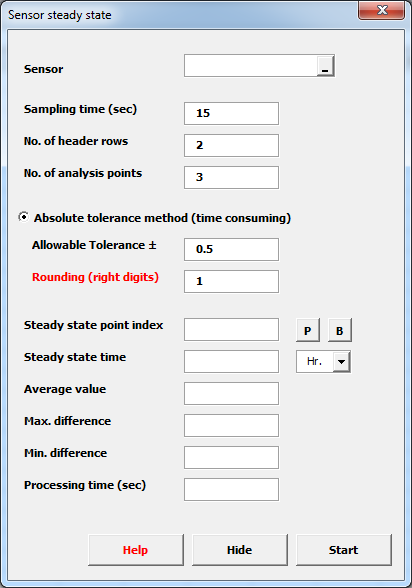
Pull-down steady state detection:


Compressor startability test analysis:


Test summary:


الخميس، 6 فبراير 2014

Detecting local minimum and maximum points

In this post, I introduce a new method to detect local minimum and local maximum points for a curve drawn by a discrete set of points. That means we don't have a mathematical formula for the curve and as a result we can't calculate local minimum and maximum points by differentiation to detect points of zero slope. I needed this method to detect local minimum and maximum points for a series of points (more than 30000 points) that are recorded by data acquisition system (temperatures). 

If noise is exist in values and the points don't seem to form a single continuous mathematical function (more than function, so the local maximum and minimum points may be sharp vertices), then this method is highly recommended, but with some improvements needed.

The method simply is to divide the domain into relatively large number of divisions and detect the global maximum and global minimum of each division. The method looks like the bisection method for solving equations by iteration.

From one side, the global maximum in the division should be compared with the values at the start and the end of the interval. If the global maximum is not on the interval boundaries (larger than boundary points) , then it is a local maximum. The same concept applies for the detection of the local minimum. If the local minimum is not on the interval boundaries (lower than boundary points), then it is a local minimum.

The following illustrative figure (which is not my case) is for a friction-damped vibrating mass-spring system (Coulomb dry friction model) showing the displacement of mass versus time.

The white points show the boundary points of intervals, the green points show the local maximum points, and the blue points show the local minimum points. 

For sure, some divisions will not contain local minimum or maximum points, while some will contain. Theoretically, number of divisions should be higher than the number of local minimum and maximum points.

One of the draw backs of this method is when the local maximum or minimum point is coincident with one of the interval boundaries (see the red point). This drawback can be solved by iterating with different number of subdivisions and check if there is any change or not (looks like the boundary conditions analysis in CFD). Also, it can be solved by shifting the boundaries of divisions with small amount and re-apply the method again.

Another draw back is when there are more than one point having the same maximum value. 


Update:

In case of a curve that is cycling around an average value; a smart way to detect number of divisions is to calculate the average of the curve, then the interval boundaries are composed of the following points:

- Start point of the curve
- Intersection points of average line (reference line) with the curve
- End point of the curve

The following figure shows the implementation of automatic detection of number of divisions. The reference line may not be the average value, but may also be a user-input value.

الاثنين، 13 يناير 2014

Thermoelectric cooler Alcohol bath

For the purposes of calibration of temperature sensors at low temperatures or for testing thermo-switches the following layout may be used to make Alcohol cooling bath. The idea beyond using Alcohol is that it has low freezing temperature (-114 C) so it will not freeze in the negative temperature ranges like water which will act like an insulator when it turns into ice. Also, using air as a cooling medium is obviously not reliable because it has low convection heat transfer coefficient, low thermal capacity (and hence low temperature stability), besides the moisture content of air will form frost on the cold sides of the thermoelectric cooler modules resulting in insulation effect.


As you can see in the image above, the insulation cap (on top) not only work as an insulator, but it also prevents the evaporation and loss of Alcohol which has high volatility. 

The cooling capacity may be increased by just increasing the number of thermoelectric coolers (something like the image below). Increasing number of thermoelectric cooler modules for the same path will increase its volume resulting in larger steady state time and may lead to radial non-homogeneity of temperature distribution across the bath.


الجمعة، 10 يناير 2014

Stair climbing wheel

This post is just a demonstration for the layout and basic dimensions of a stair climbing wheel. Stair climbing wheels are commonly used in market carts and appliance trucks. There are two types of them: manual drive and motor drive. The later is used mainly in robots, space landers, and some toy cars. 

Stair climbing wheels are (in most cases) only efficient in stair climbing because they are not supposed to turn right or left while climbing stairs. Using stair climbing wheels in carts or trucks (the truck will have two units of wheel cluster) that move on flat grounds is difficult when you try to turn right or left (specially when the spacing between wheel centers are large) because the system will have 4 fixed-direction parallel wheels (imagine a car with four wheels that all of them are aligned and parallel, it will never turn).

Stair climbers should be designed for a given stair step because they will not work properly for any height.


How to make square cavity in ABS plastic sheet

This post is talking about how to make a square cavity cut in thick ABS plastic sheet (or any soft plastic sheet like HIPS). In my case it was 5 mm thick ABS sheet. I needed this when I was trying to make a fixture for a Peltier cooler 40 mm x 40 mm. The tools you will need are almost available at home:

1. Stainless steel ruler
2. Rigid blade cutter
3. Cup saw bit
4. Electric drill
5. Lineman plier (http://en.wikipedia.org/wiki/Lineman%27s_pliers)

 Just follow the instructions on the image below.